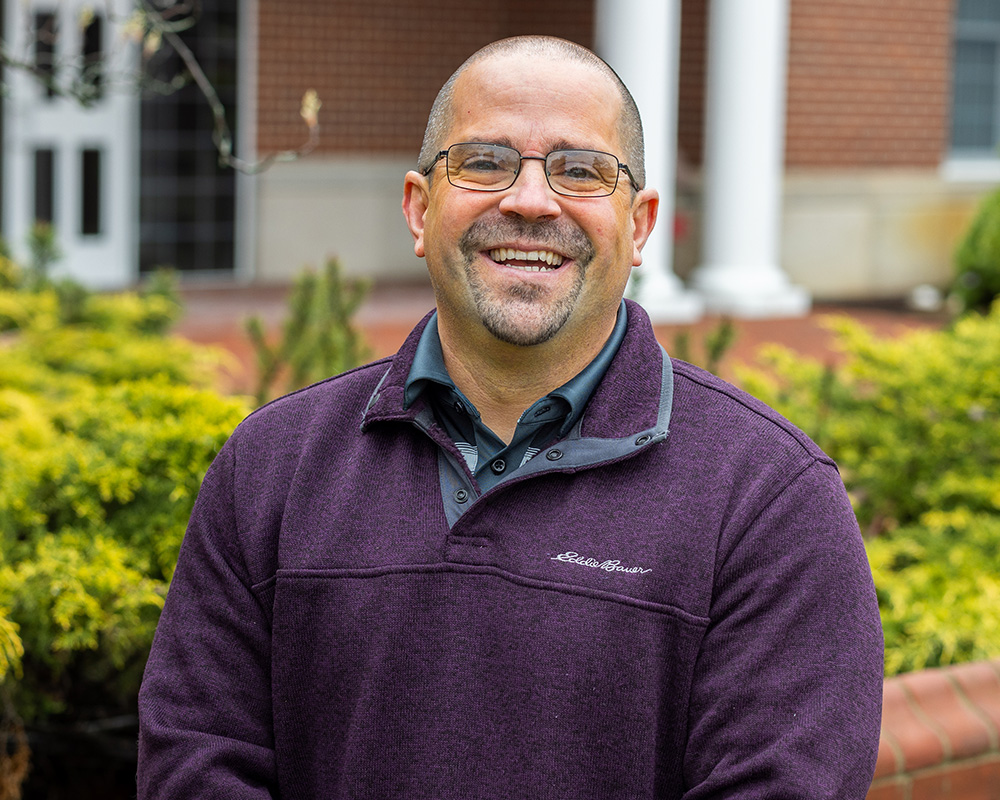
When Dr. Chris Chartier first stepped onto the Ashland University campus over a decade ago, he knew he had found his academic home. As a social psychologist passionate about teaching and research, Chartier was drawn to Ashland’s intimate class sizes, tight-knit community and unwavering commitment to student success.
“I was really impressed by Ashland’s focus on the individual student experience,” Chartier says, referencing his undergraduate years at Indiana University and graduate work at Miami University in Oxford, Ohio. “Coming from larger university environments, I knew I wanted to be at a place where I could develop meaningful relationships with my students and have a tangible impact on their lives.”
Chartier’s desire to connect with and empower students has been a driving force throughout his career at Ashland. As a professor, he has become known for his dynamic, relatable teaching style, seamlessly weaving real-world applications into his psychology curriculum. Whether he’s introducing first-year students to the discipline or guiding seniors through advanced seminars, Chartier’s infectious enthusiasm and individualized approach have inspired countless undergraduates.
Chartier’s dedication extends far beyond the classroom. As the director of Ashland’s International Collaborative Research Center, he has spearheaded a series of ambitious, globally-collaborative studies that are pushing the boundaries of the psychology field. Previously, he founded the Psychological Science Accelerator, a groundbreaking initiative that united researchers from around the globe to address complex psychological questions. Now, with prestigious grants from organizations like the John Templeton Foundation, Chartier and his team are focusing on the psychology of moral decision-making and exploring cultural differences in how people perceive concepts like “dignity” and “honor.”
“These are the kinds of big, complex questions that fascinate me as a researcher,” Chartier says. “And the fact that we’re able to tackle them on a truly global scale, with the help of an international network of collaborators, is just incredible. It’s the kind of work that simply wouldn’t be possible without the support of external funding.”
Chartier is quick to acknowledge the vital role that donations play in empowering faculty and students at Ashland to pursue transformative research and educational initiatives. Whether it’s enabling the hiring of dedicated scientific staff or providing undergraduates with hands-on research opportunities, philanthropic support has been essential to the success of Chartier’s work.
“Grants and donations open so many doors for us,” he says. “They allow us to dream bigger, take on more ambitious projects and give our students experiences that will truly shape the trajectory of their lives. Without that kind of investment, we’d be limited in what we could achieve.”
As Chartier looks to the future, he’s excited about the prospect of continuing to expand the reach and impact of Ashland’s psychology program. With plans to seek renewal of the Templeton Foundation grant and explore new funding opportunities, he’s confident the university will remain at the forefront of cutting-edge research and education.
“This is just the beginning,” Chartier says with a smile. “The work we’re doing here has the potential to transform not just individual lives, but the very fabric of our society. And I’m honored to be a part of it, alongside such an incredible community of students, faculty and supporters.”