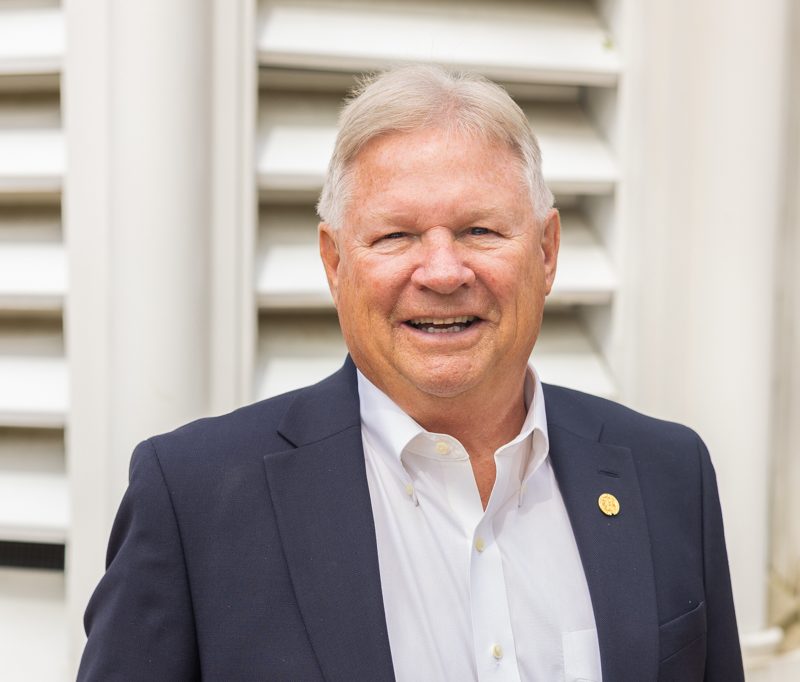
Fred Finks still remembers the first time he stepped foot on Ashland’s campus. He was just 15, visiting with his pastor’s family for a denominational youth conference. “I remember going home and telling my parents, ‘This is where I want to go to college,'” he says. That visit sparked a lifelong connection to a place that would shape his identity, launch his career and eventually bring him full circle—from first-generation student to university president.
Fred grew up in a small town in Virginia’s Shenandoah Valley, the son of a beautician and a chartered bus driver. Attending a private college out of state seemed out of reach, but Ashland made it possible. Through the encouragement of mentors and the support of scholarships, he enrolled in 1965. “My parents did everything they could, but it was still a stretch,” he says. “Ashland made a promise: you won’t pay more than you would at a public university back home. And they kept that promise.”
At one point, Fred’s mom voiced her doubts, convinced he’d be scrubbing toilets to earn his keep. “I told her, ‘If I have to scrub toilets to go to Ashland College, I’ll scrub toilets,'” he says, laughing. “Thankfully, I never had to—but I would’ve.”
His years as a student were marked by deep relationships, transformational mentorship and a strong sense of community. He started as a history major before switching to psychology, minored in religion and threw himself into campus life. He served as student body vice president and developed a close friendship with then-president Dr. Glenn Clayton. “He and his wife invited students into their home, trusted us with real responsibilities and lived out the values they talked about,” Fred recalls. “Dave Cooksey and I even parked cars and babysat for them. That shaped how I understood leadership.”
After graduating in 1969 and completing seminary in 1972, Fred spent a decade pastoring a church in Elkhart, Indiana. The church grew rapidly, becoming a vibrant young-adult congregation. But in 1982, Ashland came calling. Despite initially turning down the role, he ultimately accepted the opportunity to lead Ashland Theological Seminary—a decision he credits to persistent prayer and wise counsel. “It took six trips back and forth before I was sure,” he says. “But when I woke up that final morning, I knew. God made it clear.”
For the next 24 years, Fred served the seminary as president, shaping generations of pastors and church leaders while championing programs like spiritual formation groups. In 2006, he was appointed president of Ashland University—the very institution that had once offered him a foothold in higher education. “Serving your alma mater is one of the highest honors you can imagine,” he says. “It brought everything full circle.”
As president, Fred focused on expanding student access, strengthening donor relations and cultivating a campus culture grounded in care. He led the fundraising effort for the Dwight Schar College of Education and was instrumental in bringing the football stadium and athletic complex to campus. He also launched a leadership academy to develop future university leaders from within.
“Accent on the Individual isn’t just a motto,” Fred says. “It means you’re not a number. You’re not lost in the crowd. Someone knows your name. Someone believes in you. That culture shaped me, and I wanted to make sure it shaped others, too.”
Now retired, Fred remains a steadfast supporter of Ashland. He and his wife, Holly, have established scholarships at both the university and the seminary in gratitude for what the institution gave them. “Ashland made me who I am,” he says. “That kind of foundation doesn’t just fade. It stays with you. It calls you to give back.”
Looking back, Fred says he’s most proud of the lives touched—the students mentored, the doors opened, the faith quietly lived. “I didn’t set out to be a president,” he says. “I set out to follow a calling. And Ashland gave me the space to do that, again and again.”
Necessary cookies are absolutely essential for the website to function properly. This category only includes cookies that ensures basic functionalities and security features of the website. These cookies do not store any personal information.
Any cookies that may not be particularly necessary for the website to function and is used specifically to collect user personal data via analytics, ads, other embedded contents are termed as non-necessary cookies. It is mandatory to procure user consent prior to running these cookies on your website.